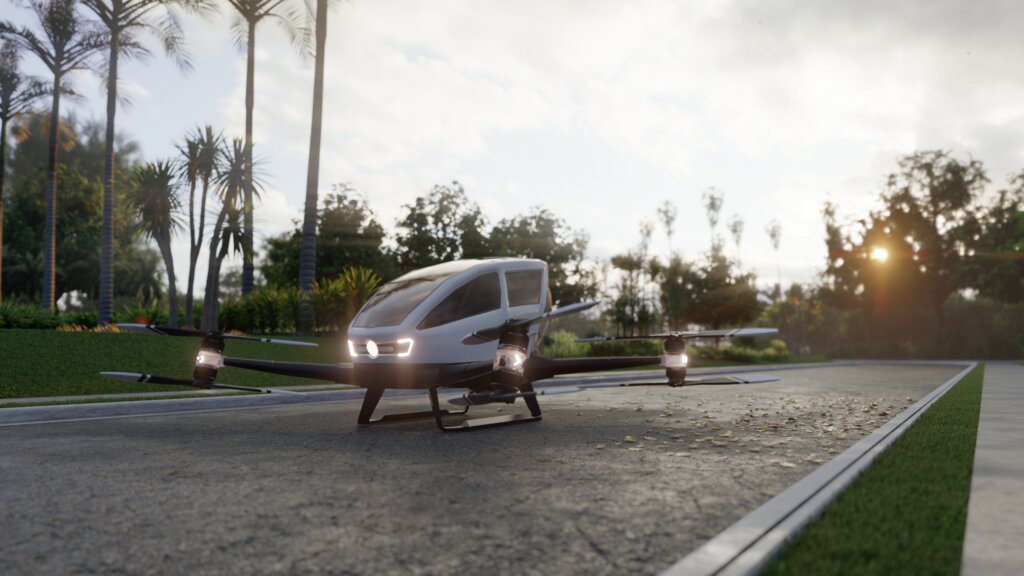
The future of rideshare could be airborne — if designers can mitigate the noise these aircraft produce.
Many air taxis are eVTOL (electric vertical takeoff and landing) aircraft, which use multiple small rotors operating at lower speeds. Rather than producing a single dominant sound, these rotors generate overlapping frequencies, resulting in a more complex, perceptible noise profile.
While they are generally quieter than helicopters, the sound of multiple rotors whirring is widely considered more annoying to the human ear. The aircraft are also expected to fly closer to residential communities than airplanes, exacerbating noise pollution. Prolonged exposure to eVTOL noise can lead to health problems, including stress, fatigue, headaches, and hearing loss.
Companies are trying to win public support by reducing rotor noise. Flight noise complaints have been consistent across aviation projects, fueling community opposition. For air taxis, this could trigger regulatory scrutiny during the authorization process, stall route approvals, and slow the industry’s growth — sparking a race to design quieter eVTOLs.
“Making the system quieter means moving from a simple propulsion setup to a much more complex one, with more parts and tighter coordination,” aerodynamics and aeroacoustics researcher Feroz Ahmed said.
To improve public perception of air taxis, engineers are designing quieter and less annoying propulsion systems that are harder to manufacture and scale.
The FAA limits the perceived noise level for air taxis to 82 decibels (dB), approximately the level of a vacuum cleaner. This limit is based on Sound Exposure Level, which accounts for both loudness and duration, meaning persistent noise can still exceed thresholds at lower volumes.
“When we talk about noise, we’re really talking about perceived noise level — how annoying it is to people,” Marilyn Smith, director of Georgia Tech’s Vertical Lift Research Center of Excellence, said.
The distinction matters for certification. A vehicle can pass loudness tests and still generate community complaints, creating a potential deployment risk for companies, such as Archer Aviation, and Joby, as they look to scale operations in dense urban environments.
Many air taxis can operate below that threshold, but their noise may still be perceived as a nuisance. Joby, for example, has reported aircraft noise of about 45 dB(A) at altitude. Takeoff and landing, the loudest phases of flight, are typically not reflected in those figures. Joby’s peak noise during those phases reached 65 dB.
Different rotor designs impact an air taxi’s acoustic signature. Because eVTOL sounds are tonal and vary in pitch and intensity over time, they can stand out to the human ear even when the overall volume is lower.
Elon Musk has described current air taxi sounds as “a giant beehive of super noisy bees,” while co-founder of aviation technology research firm Valour Consultancy, Craig Foster, has said the sound can “cut through the urban din like a persistent mosquito.” A NASA study agrees.
One of the main strategies for reducing eVTOL noise is lowering rotor speed, which prevents blade tips from approaching supersonic flow, a major source of high-frequency noise. But slower rotors produce less lift, especially in hover, Smith said.
To compensate, designers add more rotors, with some testing as few as two and others using up to 16.
That is where noise becomes a quality-control problem. Distributed electric propulsion systems spread rotors across the aircraft, making acoustic performance sensitive to small changes in rotor speed and timing. During takeoff and landing, when rotors often tilt from vertical to forward flight, those differences can change the aircraft’s noise profile.
“With many rotors operating close to each other, small differences in their speed or timing (phasing) can create extra noise and vibration that would not exist in simpler designs,” Ahmed said.
Ducted fan designs create a different manufacturing challenge. Because the fans are integrated into the airframe, the spacing between the rotor and duct must be tightly controlled. Even millimeter-level deviations can shift pitch and tonality. Acoustic liners can also vary by structure and bonding quality, leading to unpredictable changes in noise output across units.
Adding more rotors increases the number of components that must be manufactured, assembled, and synchronized, making it harder to maintain consistent acoustic performance across aircraft.
“Small differences in blade geometry, mass balance, surface finish, or alignment can introduce imbalance (both mass and aerodynamic imbalance),” Ahmed said. “While such variations may be acceptable in a single rotor system, in multi-rotor configurations these imbalances can lead to increased vibration and changes in noise behavior.” These effects can include more pronounced tonal noise and pitch shifts.
This is a first-pass yield problem disguised as an acoustics problem. Every rotor added to reduce noise is also another component that must be manufactured to identical tolerances across every unit in the fleet.
As production scales, manufacturers must ensure that hundreds of aircraft built across different runs produce consistent acoustic output. Without tight control over variation, fleets could drift outside acceptable noise thresholds.
Part of the problem is that testing has not caught up with the complexity of these systems.
“While we understand noise at a component level, we still lack a system-level framework that connects these isolated insights to real aircraft behavior and human perception,” Ahmed said.
Closing that requires end-of-line acoustic testing for every unit, ensuring blades are in sync, and establishing quality-control processes borrowed from precision turbine manufacturing. The companies that find early success will have a quality system that can reproduce quiet performance consistently across the fleet.
Air taxi companies are trying to prove that the market is ready for them. Joby ran a test flight in April 2026 between John F. Kennedy Airport and Manhattan. Although the test was successful, videos show the flight noise remains distinct over the city, suggesting the technology has not yet reached a level that most urban environments will tolerate.
A gap between research and production partly explains the difficulty of predicting and controlling noise levels in the field.
Because aircraft are tested only in controlled conditions, even small manufacturing variations can disrupt acoustic performance at operational scale. Until companies can control how those variations propagate through multi-rotor systems, air taxi deployment will remain constrained by a manufacturer’s ability to consistently hit a system-level noise requirement.