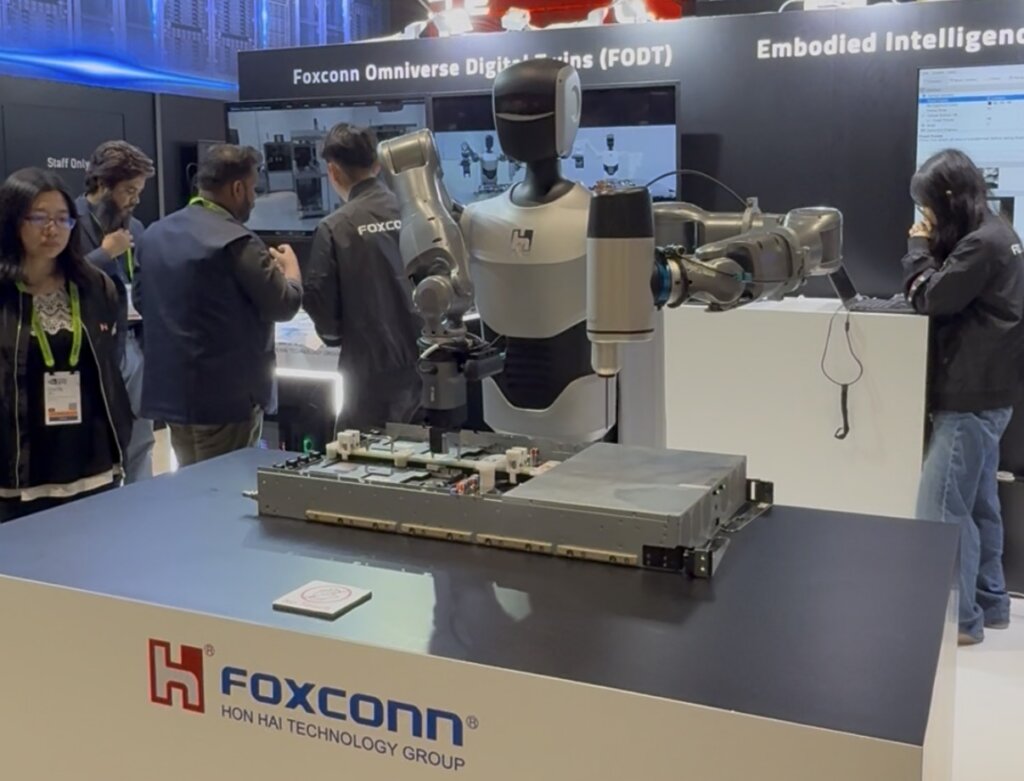
Foxconn is about to deploy humanoid into real factory environments with a trial that tests the sector’s marquee push into physical AI.
At GTC 2026, senior robotics engineer Wei-Jiun Lee told Build Better that Foxconn plans to deploy “fewer than 10” humanoid robots on a server production line at its Houston facility in mid-April.
The robots will support the assembly of NVIDIA GB300 AI servers, according to Lee.
At the conference, Foxconn demonstrated its wheeled-base humanoids performing structured, repetitive tasks such as part transfer, screw fastening, and materials handling. The system uses fixed grippers, with plans to swap end effectors depending on the task, according to Lee. It is trained through a combination of simulation and on-site iteration using NVIDIA’s Isaac Sim stack, according to Foxconn’s press release.
The pilot reflects a broader industry pattern: humanoid role in production remains narrow and tightly controlled.
Lee is unsure when the humanoids will advance to harder tasks.
“We don’t have a timeline,” he said. “I hope that in the future it can handle more complex and simple manipulation tasks and collaborate better.”
Foxconn declined to comment further on the scale of its deployment plans.
GM at Hon Hai Technology Group, the Taiwanese electronic manufacturer better known as Foxconn, Leo Guo, spoke at GTC 2026 about what it takes to build and scale AI factories. “Once the human robot is deployed to the factory, that’s not the end,” Guo said. “We still need to collect the data, as I mentioned earlier, the data flywheel,” a self-reinforcing loop where systems generate data to improve themselves.
This reflects a broader trend in factory deployment of humanoids, where companies are constrained by a lack of real-world training data.
Other companies are following a similar path, including Agile Robots. The humanoid company has prioritized making humanoids adaptable and autonomous for manufacturing environments.
“We just launched this robot (Agile One) in November last year…we’re still ramping up production in Germany, and running test pilots in our own productions,” Agile Robots spokesperson Henner Brandes said.
Solomon’s, an industrial automation and robotics company, Director of Sales and Operations Joseph Tsa estimates it could take roughly three years for humanoids to become fully functional in real-world environments, citing hardware limits and gaps between simulation and real-world physics.
Across the industry, the pattern is consistent: Humanoids can enter production environments, but only in tightly scoped roles where variability is low and system demands are controlled.
Getting robots onto the line is no longer the barrier.
Now it’s scaling beyond pilots into real production.