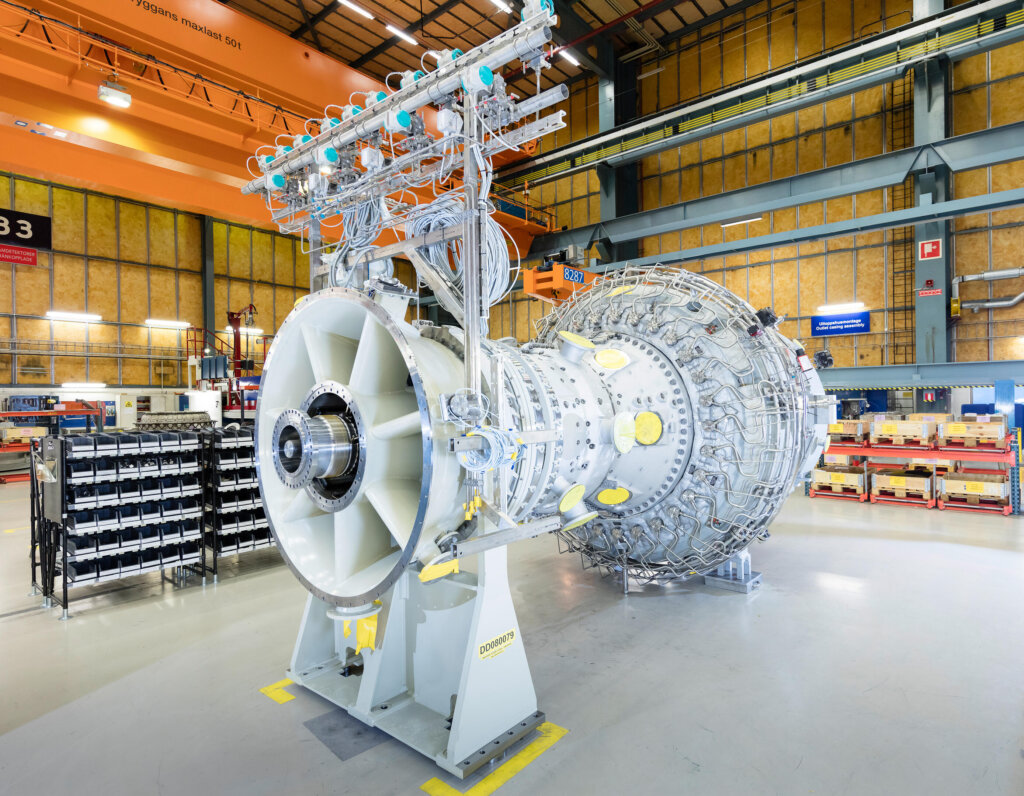
Artificial intelligence is driving a rapid increase in electricity demand.
The power industry’s response — grid expansion, renewables, and new transmission lines — takes years to scale, creating a mismatch between infrastructure timelines and data center growth.
When new power is needed quickly, U.S. operators typically turn to gas-fired plants. Unlike wind or solar, gas turbines provide consistent, dispatchable electricity that can be deployed at scale more quickly. For near-term capacity, they are often the only viable option.
Currently, power demand is met through two overlapping strategies: large utility-scale gas plants connected to the grid and smaller on-site generation systems deployed directly at data centers.
But both approaches are running into the same problem: not enough turbines. Turbines ordered today may not be delivered until 2029 or later, according to Siemens Energy, one of the largest manufacturers of gas turbines.
This moment resembles past turbine booms — but where the early 2000s surge was driven by cheap natural gas, today’s is driven by AI’s insatiable appetite for electricity.
“Now it’s: ‘We need more electricity, and we’ll pay whatever the fuel cost is to get it,’” said Stephen Lynch, Director of Penn State’s Center for Gas Turbine Research, Education, and Outreach
Meeting that demand depends on how quickly turbine manufacturing can scale.
When a data center operator needs 300 to 500 megawatts of new power, natural gas is often the most practical option. Solar and wind require far more land — up to 1,800 to 3,000 acres for solar at that size (plus storage), and still can’t guarantee output when the sun isn’t shining or the wind isn’t blowing. A combined-cycle gas plant can deliver 500 to 800 MW on a much smaller footprint, according to Lynch.
Combined-cycle gas plants generate power in two stages, using exhaust heat from a gas turbine to drive a second turbine. But fully building out the system to deliver its maximum output can take years, with timelines often stretching two to seven years.
“Getting a gas turbine onsite is only a small part of the balance of plant,” Lynch said. The rest — heat recovery, steam generation, and a second turbine — adds significant time.
Renewables and storage are advancing and could eventually reduce reliance on gas. But their variability and the scale of storage required limit their ability to replace always-on power today.
To avoid long development timelines associated with utility-scale plants, some data center operators are pursuing on-site generation to deploy power faster.
This includes co-located gas plants and smaller turbines derived from aircraft engines. Most data centers still plan to connect to the grid eventually, but timelines remain uncertain, according to Siemens Energy, while some developers plan to operate behind the meter indefinitely.
These systems can be deployed more quickly than large utility-scale plants, but often trade efficiency, lifespan, and proven reliability for speed.
“We haven’t been running those engines long enough to know how long they’re going to last,” Lynch said.
Startups are pushing further, with companies like Boom Supersonic and Exowatt developing modular turbine and thermal storage systems. Established players are also exploring modular approaches. Siemens Energy, for example, has partnered with Eaton to develop integrated, microgrid-style power systems designed to speed deployment for data centers.
But none of it escapes the same turbine manufacturing constraints.
“The bottleneck is still… the casting process,” Lynch said, referring to the limited supply chain for turbine blades and cast components shared across both utility-scale plants and modular systems.
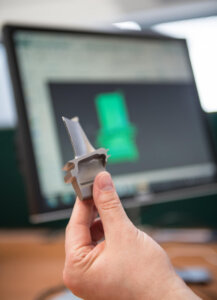
A 3D-printed gas turbine blade used by Siemens Energy for additive manufacturing applications, testing, and demonstration purposes. Photo courtesy of Siemens Energy
“The tightest bottleneck remains large castings and forgings — including blades and rotors — supplied by a very limited global base,” said David Blank, Sales Director for North America at Siemens Energy, with input from Siemens Energy VP Brian Maragno and Senior Director Jim Mozell.
Major OEMs like GE, Siemens Energy, and Mitsubishi rely on specialized suppliers — primarily Howmet and Precision Castparts (PCC) — for many of the blades, casting, and forgings now constraining production.
Gas turbines operate under extreme physical conditions. Blades sit directly downstream of combustion, where the “temperature is so high that they are about 800 to 1,000 degrees hotter than the temperature of lava,” Lynch said.
To withstand this, manufacturers use nickel-based superalloys, advanced cooling systems, and single-crystal casting — a highly specialized process with narrow global capacity.
“There are fewer countries in the world that can make single-crystal turbine blades than can make nuclear warheads,” Lynch said.
Expanding capacity is slow because it requires building new casting infrastructure. The same facilities also produce components for aviation engines, putting power generation in direct competition with aerospace.
The supply chain adds further constraints, with key materials and manufacturing capabilities globally distributed and difficult to scale quickly under shifting trade or geopolitical conditions.
Turbine blades can’t be ramped up the way server production can. They require a specialized process with hard caps on material, tooling, and production capacity.
That constraint is beginning to push some companies toward vertical integration — bringing blade manufacturing in-house to bypass suppliers. “In order to bring enough power online, I think SpaceX and Tesla will probably have to make the turbine blades… internally,” Elon Musk said in his Cheeky Pints Podcast interview.
With new equipment constrained, power operators are extending the lifetimes of existing turbines and power plants.
“A fair number of power generation companies are retaining old assets longer than they used to,” Lynch said.
Some operators lower the temperature and output to reduce component stress and extend service intervals. Others delay maintenance or push equipment beyond typical replacement timelines, according to Lynch.
Neither approach is without risk. Lower temperatures reduce efficiency, requiring more fuel per MW, and extending asset lifetimes increases the risk of failure. But with limited access to new turbines, alternatives are difficult to expand.
The current surge in turbine demand echoes past cycles, but with a different driver: capacity needs rather than cheap fuels.
This creates a difficult decision for gas turbine manufacturers. Expanding production involves building new casting facilities, investing in specialized tooling, and committing to years of capital investment.
Siemens Energy said it is investing more than $1 billion to expand U.S. manufacturing capacity, including turbine and grid equipment production, while focusing much of that effort on scaling output at existing facilities.
But demand for turbines has historically surged and cooled with changing market conditions.
Manufacturers are being asked to make decade-long capital commitments for a demand surge with an uncertain duration, and casting infrastructure that takes a decade to build could be left stranded if AI power demand plateaus or shifts.
The race to power AI is no longer just about expanding the grid or building data centers. It is about scaling an industrial base that cannot move at the speed of computing.