Tariffs imposed by President Donald Trump in April 2025 intensified the push to reshore U.S. manufacturing, particularly in electronics. But a year later, the sector is still bleeding jobs, even as TSMC, Intel, and Samsung pump billions into new facilities.
Employment in computer and electronic product manufacturing has declined by 18,100 jobs over the past year, per March 2026 Federal Reserve data, shedding an estimated 2,000 jobs since December. Total manufacturing jobs are down by 75,000 from March 2025, including roughly 35,000 in durable goods, according to the U.S. Bureau of Labor Statistics. The holdup in total job creation speaks to the time it takes to build and ramp up new facilities, but also more fundamental shifts in the industry’s underlying technologies.
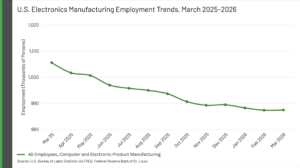
Employment in computer and electronic product manufacturing fell from 1,005,600 workers in March 2025 to 987,500 in March 2026, a decline of about 18,100 jobs over the past year. Graph by Sukhman Sahota
Still, employment is leveling — and even rising — in a few corners of U.S. manufacturing.
Transportation equipment shows signs of leveling, while subsectors such as fabricated metals and electrical equipment have added jobs, yet machinery and furniture manufacturing have declined.
Semiconductor and electronic components manufacturing accounts for 96% of the decline in electronics manufacturing jobs — representing 17,400 of the 18,100 jobs lost in the subsector.
Several U.S. policy measures and decrees, including the 2022 CHIPS and Science Act, are aimed at expanding U.S. chip production and reducing reliance on foreign supply chains. The segment receiving the most policy attention is also where employment has fallen the most.
More than 140 semiconductor-related projects have been announced across the U.S. since 2020, representing over $600 billion in planned investment, according to the Semiconductor Industry Association. These projects, such as Intel’s Ohio semiconductor fabs and TSMC’s Arizona manufacturing expansion, are expected to support hundreds of thousands of jobs over time.
Semiconductor fabrication facilities can take years to build and bring online, with production timelines often stretching into the late 2020s. U.S. projects take nearly twice as long as those in Asia due to regulatory and construction constraints, according to Semiconductor Digest.
Some analysts, however, say the disconnect may not be purely a matter of timing.
“While employment has declined in the semiconductor industry in recent years, productivity in the industry has increased. This could point to investment in robotics or other forms of labor-saving automation in the industry,” Washington Center for Equitable Growth researcher Chris Bangert-Drowns told Build Better.
As semiconductor manufacturing becomes more capital-intensive, newer facilities may require fewer workers to operate than in previous cycles, limiting how much employment rises even as capacity expands.
Manufacturing employment jobs are down modestly overall, with thousands of losses concentrated in electronics, particularly in semiconductor and electronic components manufacturing.
At the same time, investment surged, with more than $600 billion in planned semiconductor projects announced since 2020.
The gap reflects both timing and structure. Building capacity is a multi-year process, and increased automation may reduce the number of workers needed even as production expands.